Why a routine beats willpower
You can't make yourself fall asleep, but you can make yourself predictable. A wind-down routine works by repetition: run the same short sequence every night and the sequence itself becomes a cue, until starting it is already halfway to drowsy. The routine below takes about thirty minutes and uses only things you already have — including the Calming Galaxy features it was designed around.
T-minus 30 minutes: start the sounds
The routine starts with sound, not silence. Open the mixer and put on your blend — steady rain, crickets by a fire, whatever you've made yours — at a low, background volume. Starting it now, while you're still moving around, is deliberate: by the time you're in bed, the sound is already the room's normal, and your brain has begun associating it with the end of the day.
If you don't have a blend yet, build one tonight: a steady base like Rain or River, plus a texture layer like Fireplace or Crickets a notch lower, then save it. Tomorrow night, one tap restarts the whole ritual.
T-minus 20 minutes: two minutes of breathing
Before the hygiene scramble, take two or three minutes for slow breathing — it lowers the day's idle speed before you ask your body to power down. Box breathing (inhale four, hold four, exhale four, hold four) is the easiest pattern to remember; our box breathing guide has the full steps, and Calming Galaxy's guided breathing sessions can pace it for you. This is the routine's hinge: the moment the day officially ends.
T-minus 15 minutes: get ready in low light
Now do the practical things — teeth, face, tomorrow's clothes, whatever your version is — with the lights dimmed as low as workable. Bright overhead light late in the evening tells your brain it's still daytime; lamplight tells it the truth. Phone chargers live outside reaching distance for the rest of the night.
Lights out: a sleep story
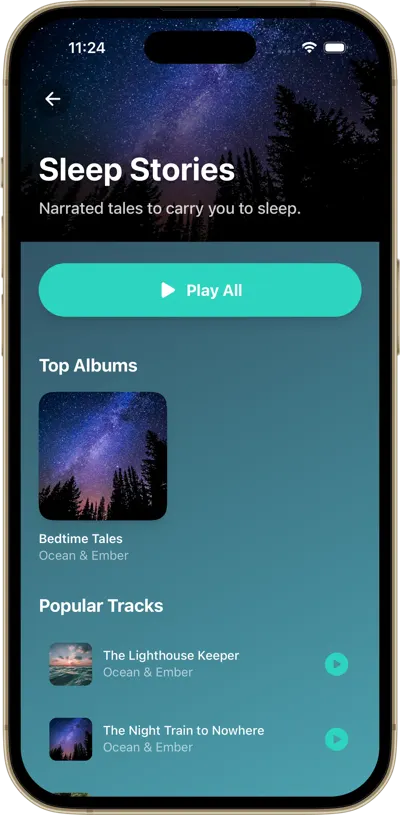
In bed, lights off, start a sleep story at a volume you can follow without effort. Stories are built for minds that won't stop narrating on their own — you half-listen, you drift, you miss the ending, and that's the design working. The Rainy Night Train to Quiet Harbour is free if you're new to the format; the full shelf lives on our sleep stories page.
Not a story night? Let the sound blend carry it alone. The routine survives substitutions; it doesn't survive being skipped.
The last step: set the sleep timer
The final action of the routine is the sleep timer — thirty to forty-five minutes suits most people. The story and sounds fade out slowly once you're under, so the night hands itself back to quiet without a sudden silence to wake you. Then the phone goes face down, and there's nothing else to do: the routine is complete, and your only job is to let it work.
Make it yours — and keep it small enough to survive
Reorder it, shorten it, swap the story for ten pages of a book — all fine. Two rules aren't negotiable: the sequence stays the same once you settle on it, because repetition is the mechanism, and the whole thing stays small enough that you'll still do it after your worst day. A fifteen-minute routine done nightly beats a perfect forty-minute one you abandon by Thursday.
If you want the environment half of this equation — temperature, light, morning light, caffeine — our sleep hygiene checklist covers it, and the two fit together: checklist for the setup, this routine for the descent.
Hear it for yourself
These guides are easier to act on than to read. The sounds they reference each have their own page — the ones marked Free play right there on the site.
Try it live
The routine's two-minute breathing step, with a live pacer — free in your browser.