Why anxiety gets louder at night
Anxiety feeds on open space. During the day, meetings, messages, and errands keep your mind occupied; at night, the inputs stop and the thoughts rush in to fill the quiet. Add a dark room, a still body, and the knowledge that you need sleep, and bedtime becomes the moment your brain finally has room to worry.
None of the tools below are treatments, and none will make anxiety vanish. What they can do is lower the volume enough for sleep to happen — which itself makes tomorrow's anxiety easier to carry.
First, slow the body down
An anxious mind lives in an anxious body, and the body is often the easier one to reach. Slow breathing — particularly a long, unhurried exhale — is the fastest lever most people have. Box breathing (inhale four, hold four, exhale four, hold four) gives the mind something exact to follow; our step-by-step box breathing guide walks through it. If counting feels like effort, just make each out-breath a little longer than the in-breath.
Calming Galaxy's guided breathing sessions are built for this exact moment — two or three minutes of paced breathing before you even try to sleep.
Give the thoughts somewhere else to go
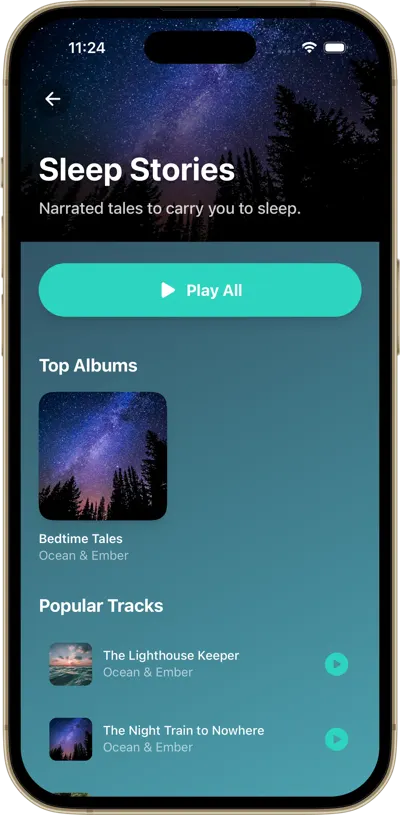
Rumination needs your full attention to sustain itself, so the trick is to offer a gentler thread. A sleep story is designed for exactly this: low-stakes narration you can half-follow until you drift off mid-sentence. You can browse what's available on our sleep stories page, or read about why the format works in our guide to sleep stories.
When the anxiety is spikier — heart racing, mind catastrophizing — grounding works better than narrative. The 5-4-3-2-1 technique (five things you can see, four you can feel, and so on) pulls attention back into the room; our grounding techniques guide has the full steps. It pairs naturally with slow breathing: ground first, breathe second, sleep third.
Don't leave the room silent
Silence sounds like the right setting for sleep, but for an anxious mind it can be an amplifier — every small noise and every thought arrives against a blank background. A steady sound like rain smooths both over: it masks the unpredictable noises that spike your attention, and it gives the listening part of your mind something boring and safe to rest on.
Keep the volume low — about the level of a quiet conversation, or softer — and start the sound before you're in bed, so it becomes part of the wind-down rather than a reaction to the worry.
Set the night up so it can't ambush you
A few structural choices make anxious nights less likely to spiral:
- Keep a consistent wake-up time — it's the strongest anchor your body clock has.
- Put a notebook by the bed; writing the worry down parks it somewhere safer than your head.
- Turn the clock face away. Clock-watching hands your brain a math problem at 2 a.m.
- Use a sleep timer with a slow fade-out, so the sound never snaps off and startles you mid-night.
If you're awake anyway
If roughly twenty minutes pass and sleep isn't coming, get up. Lying in bed marinating in anxiety teaches your brain that the bed is where worrying happens. Move to another room, keep the lights low, do something calm — a few pages of an unexciting book, another round of slow breathing — and return when you feel drowsy. It feels like surrender; it's actually training.
When nighttime anxiety needs more than an app
If anxiety is keeping you up most nights, or it's been going on for months, that's worth taking to a doctor or therapist — not because you're broken, but because anxiety-related insomnia has well-studied, effective treatments (including CBT-I, the recommended first-line therapy for chronic insomnia) that work better than any app, ours included. Breathing exercises and rain sounds are good companions on the way there, not a substitute for care.
Hear it for yourself
These guides are easier to act on than to read. The sounds they reference each have their own page — the ones marked Free play right there on the site.
Try it live
A two-minute paced session, right in your browser — box breathing, 4-7-8, or a simple long exhale.